

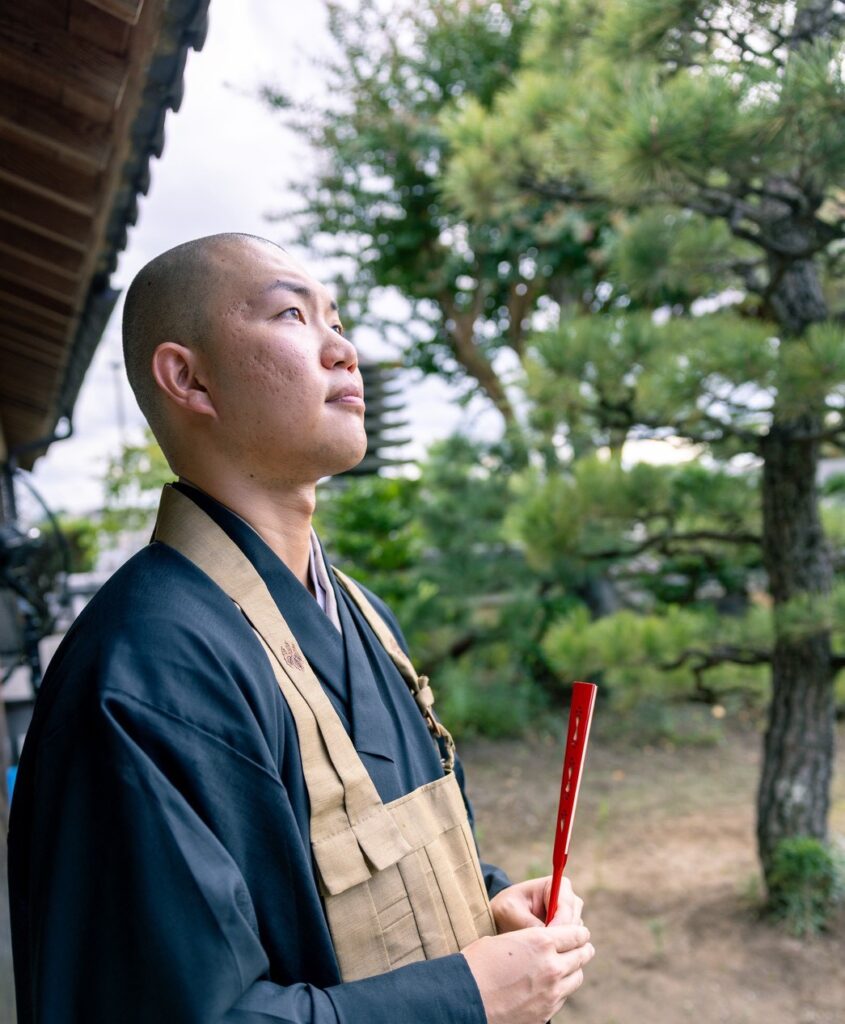
禅僧/曹洞宗

奈良を拠点に活動する曹洞宗の禅僧。海外留学を経て、駒澤大学仏教学部禅学科で禅思想を専門的に学ぶ。

曹洞宗大本山・永平寺での修行を経て、現在は奈良の禅寺を拠点に、坐禅と日常の実践を通じて「これからの時代の生き方」としての禅を探求している。学生時代には、IFAFフラッグフットボール世界選手権2018の日本代表選手に選出されるなど、スポーツのフィールドでも活躍した経歴を持つ。

現在は寺院での坐禅会や参禅指導にとどまらず、学校教育や留学前プログラム、地域コミュニティのリトリートなど、多様な場で「これからの時代の生き方」をテーマに禅の実践をつないでいる。

その語り口は、「呼吸」「姿勢」「間(ま)」の感覚を手がかりに、自分自身と世界との関係を静かに見直していくためのヒントをひらいていくもの。皆川師にとって禅は、教義を押しつけるものではなく、一人ひとりが自分自身と世界の関わり方を見つめ直すための「場」そのもの。禅を「特別な修行」ではなく、日常にひらかれた“心をととのえる実学”として伝えている。
Ryushin Minagawa
Soto Zen Monk
Ryushin Minagawa is a Soto Zen monk based in Nara, Japan. After spending time studying abroad, he went on to major in Zen Studies in the Faculty of Buddhist Studies at Komazawa University.
Following formal monastic training at Eiheiji, he now continues his practice at a Zen temple in Nara, exploring Zen as “a way of living for the coming age” through zazen and everyday life. As a student, he was selected for the Japan national team at the 2018 IFAF Flag Football World Championship in Panama, bringing high-level athletic experience into his understanding of discipline and practice.
Today, his work extends beyond the temple into school education, pre–study abroad programs, and community retreats, where he shares Zen practice around the question of how to live in the present era.
In his teaching, Minagawa uses the felt quality of breath, posture, and ma—the living space between things—as entry points for quietly re-examining one’s relationship with the world. For him, Zen is not about imposing doctrine, but about creating a shared space in which each person can reconsider how they relate to themselves and to the world. He presents Zen not as a remote, special discipline, but as an accessible, practical way of recalibrating the mind in everyday life.
副住職 皆川隆真に聞く、
坐禅における「呼吸」と「揺らぎ」
僧侶になるきっかけとなった経験
私は現在28歳になります。得度式(僧侶になるための最初の儀式)自体は小学校4年生の時に終えているため、僧侶としての形はずっと以前からあったことになります。
寺で生まれ育ったので、この道は私にとってある種の必然的な流れだったのかもしれませんが、当時、将来が決まっているということに葛藤を抱きながら過ごしていました。将来の夢を自由に選べないことへの、言葉にしづらい悶々とした思いを抱えていたのです。
この考えが大きく変わったのは、高校時代にアメリカ・アラスカ州へ留学したときでした。
現地では、私に日本の文化(茶道、書道、侍など)について質問を投げかけてくれる人がたくさんいました。しかし、その頃の私は十分に自分のルーツと向き合えておらず、その問いにほとんど答えることができませんでした。日本人でありながら、自国の文化について何も伝えられなかった自分自身に、強い悔しさと恥ずかしさを覚えたのです。
この経験をきっかけに、改めて日本文化への関心が深まりました。特に、禅の思想や美学が、日本の建築や庭園、芸事といった文化の根幹に深く反映されていることに気づいたのです。
そこで私は、禅宗の僧侶になることは、「文化人」として日本文化の魅力を国内外に伝えていくための、最も素敵な選択肢なのではないかと考えるようになりました。
禅の思想
・実践と自力本願
禅宗は、経典の解釈や学問も大事にしつつ、坐禅や作務といった実践に、より重きを置く宗派です。
自分の修行を律し、自分の心を正していくという、「自力本願」的な考え方が特徴です。
・日常すべてが修行
禅宗には「行住坐臥(ぎょうじゅうざが)」という禅語があります。
「行く、止まる、座る、臥す」といった、日常生活のすべてが修行である、という考え方です。
これは、日本の「〜道」と呼ばれる文化──茶の湯や武道、芸事などにも、強く反映されている思想だと感じています。
・無功徳
また、禅宗が大切にしている概念に「無功徳(むくどく)」があります。
これは、修行や行動の動機として見返りを求めない、という考え方です。
見返りを求めないからこそ、見返りを求めていた時以上に、貴重な気づきやご縁を得ることがあるのではないかと私は考えています。
「吸う」と「吐く」のバランス
現代社会では、情報や知識、経験を「吸うこと」(インプット)に意識が偏りがちです。
しかし、吸った分は必ず吐かなければ、心も体も苦しくなってしまいます。吸い溜めてしまえば、心はすぐにいっぱいになってしまうでしょう。
「吸う」と「吐く」のバランスがあるからこそ、呼吸は自然に整います。
私たちの心身にも、肩の力を抜いて脱力できるような「吐くこと」(アウトプット/デトックス)が欠かせません。
日本語の「呼吸」という言葉も、「吐く」「吸う」の順で書かれています。まずは吐くことが最も大切なのです。
私が坐禅を勧める理由の一つは、この「吐く」というキーワードを意識して坐禅を実践することで、身体・呼吸・心が脱力していく中で、自然と整えられていく感覚を楽しめるのではないかと感じているからです。
深く吐き切ると、体は自然に、何の意図もなく吸おうとします。
だからこそ、しっかり吐くほど、より健やかな呼吸のサイクルが生まれていくのだと思います。
現代社会では、どうしても吸い込んでばかりの日々になりがちです。
そんな今の時代だからこそ、脱力を大切にする禅宗の教えは、「吐く」という側面から見ても、大きな価値を持っていると感じています。
坐禅の実践においても、まずは自分にとって心地よい呼吸のリズムを見つけるために、「吐くこと」を大切にしてくださいとお伝えしています。
そして、吐いた後は、体に任せた無意識の呼吸へと、自然に移っていくことを大切にしてほしいと思います。
一元論的な世界観
多くの方は、物事の判断基準を二元的に捉えがちではないでしょうか。
自分に合う・合わない、好き・嫌い、楽しい・楽しくない、良い・悪い──。
このように切り分けることで、世界を分かりやすく認識できるという利点は確かにあります。
本屋を歩けば、「やるか、やらないか」「俺か、俺以外か」といった言葉も目にしますし、強い説得力を感じることもあるでしょう。
しかし、果たして世界は本当に、そんなに単純な二元論で成り立っているのでしょうか。
仏教では「縁起」という教えのもと、物事には単独で存在するものはなく、すべてが互いに影響し合って存在していると考えます。
その関係性を感じ取ることで、人は安心感や帰属感を得て、心身を安定させ、より冷静に物事の本質を観ることができるのではないでしょうか。
私たちが何かを切り分けようとする線は、意識や見方によって引かれているものなのかもしれません。
しかし、簡単に二つに分けられないからこそ、そこには曖昧な境界、つまり「揺らぎ」が生まれます。この揺らぎに悩んでいる方も、多いのではないかと思います。
一元的に世界を観ると、それはグラデーションであり、美しさでもある。
特に禅宗では、この曖昧さや「間」を否定せず、ただ静かに観察することを大切にしています。
それは坐禅の中でも起こります。
坐っていると、感情や思考、理性が次々と現れ、心の中に揺らぎが生じます。しかし、それらに巻き込まれず、静かに観察していくのです。
やがて心が鎮まってくると、呼吸していることや観察していることさえも忘れ、自分という存在すら薄れ、座っているその環境に溶け込んでいくような感覚になります。
それは、墨を半紙に垂らしたとき、じんわりと境界線が薄まっていく感覚に近いかもしれません。
その曖昧な感覚の中で、最初に浮かんでいた感情や思考も自然と薄れ、心も身体も軽く、クリアになっていきます。
脳科学的には、一瞬のゾーンのような覚醒状態とも言われており、少なくとも多幸感に包まれる感覚があると思います。
この感覚は、言葉で完全に表現できるものではありません。実際に実践することでしか体感できないものです。
だからこそ、頭を使いすぎて疲れている現代の方々にこそ、身体全体を使ってこの美しい揺らぎを観察し、心を静め、自分という境界が環境と溶け合う一元的な感覚を体験してほしいと思います。
それが、心を落ち着かせ、より多角的な視点をもたらしてくれるのではないでしょうか。
坐禅道場について
先代の住職である祖父は、戦争を経験し、生と死に真正面から向き合ってきた人でした。その中で、心を落ち着けてくれる坐禅の大切さを、深く実感していたのだと思います。
ただ当時は、その思いを伝えるための場所がありませんでした。
祖父は托鉢をしながら全国を回り、多くの方々の支援を受け、昭和42年頃に三松寺の坐禅道場を建立しました。
そこには、「禅の心を後世に残し、大切に伝えていきたい」という強い願いが込められていたのだと思います。
当時、日本には坐禅を専門に行う施設がほとんどなく、この道場は大本山永平寺の認可道場としても認められています。
これは、「禅の心、坐禅の基礎をしっかりと伝えてほしい」という本山の思いの表れでもあります。
また、当時この地域には、子どもたちが習い事を学べる場所も多くありませんでした。
そこで祖父は、坐禅道場としてだけでなく、合気道や書道といった禅にゆかりのある部芸を一つの場所に集め、地域の子どもたちが学び、育っていける場をつくろうと考えました。
それは、坐禅だけでなく、社会全体を見据えた取り組みだったのだと思います。
今後の展望
この道場という素晴らしい環境を預かる立場として、三松寺を、奈良市や関西で禅について知りたいと思った方が、まず一番に思い浮かべる寺院にしていきたいと考えています。
個人的には、高校生の頃に抱いた思いの通り、僧侶であると同時に文化人として、禅の思想を切り口に、日本文化の魅力を世界へ伝えていきたいという願いがあります。
そして、日本の若者たちが日本文化の素晴らしさやオリジナリティに気づき、「日本人で良かった」と思える人が増えるような活動をすることで、日本の活力を高めていきたいと考えています。
Sanmatsu Zen Temple (pronounced Sanshō Zenji)
Vice Head Priest Ryushin Minagawa on
“Breath” and “Fluctuation” in Zazen
The Experience That Led Me to the Path of Priesthood
I am currently 28 years old. I completed my tokudo ordination ceremony—the first formal step toward becoming a Buddhist priest—when I was in the fourth grade of elementary school. In that sense, the form of being a monk had existed in my life from a very early age.
Having been born and raised in a temple, this path may have seemed inevitable. At the same time, I spent my younger years quietly struggling with the feeling that my future had already been decided. I carried a persistent sense of frustration about the lack of freedom to choose my own path.
This perspective changed significantly when I studied abroad in the U.S. state of Alaska during high school.
There, many people asked me about Japanese culture—tea ceremony, calligraphy, samurai, and more. At that time, however, I had not yet truly faced my own roots, and I found myself unable to answer their questions. I felt a deep sense of regret and embarrassment at being unable to express anything meaningful about my own culture, despite being Japanese.
This experience became a turning point. I began to take a renewed interest in Japanese culture and came to realize that Zen philosophy and aesthetics form the foundation of Japanese architecture, gardens, and traditional arts.
I came to believe that becoming a Zen priest was one of the most meaningful ways to live as a cultural practitioner—someone who could share the depth and beauty of Japanese culture with both Japan and the wider world.
Zen Philosophy
Practice and Jiriki-hongan
Zen Buddhism values teachings and study, while placing even greater emphasis on practice—such as zazen (seated meditation) and samu (mindful daily work).
It is characterized by a jiriki-hongan–like approach, in which one disciplines oneself and refines the mind through one’s own practice.
All of Daily Life as Practice
In Zen, there is a phrase known as gyōjūzaga—walking, stopping, sitting, and lying down.
It expresses the idea that every aspect of daily life is itself a form of practice.
This way of thinking is deeply reflected in many Japanese “-dō” traditions, such as the tea ceremony, martial arts, and other classical arts.
Mukudoku (Practicing Without Seeking Reward)
Another important concept in Zen is mukudoku.
It refers to acting without seeking reward or outcome.
Paradoxically, it is often when we let go of the desire for reward that we encounter deeper insights and more meaningful connections—sometimes even more so than when we were consciously seeking them.
The Balance of “Inhaling” and “Exhaling”
Modern society tends to emphasize “inhaling”—absorbing information, knowledge, and experiences.
However, if we only inhale and never exhale, both body and mind become strained. When we accumulate too much, the heart quickly becomes full.
Breathing naturally finds balance only through both inhalation and exhalation.
In the same way, our bodies and minds require moments of release—a form of exhaling, detoxifying, and letting go.
In Japanese, the word for breathing (kokyū) is written in the order “exhale” first, then “inhale.” Exhaling comes before inhaling.
One reason I encourage the practice of zazen is that, by focusing on this idea of “exhaling,” practitioners may experience how the body, breath, and mind gradually relax and come into balance.
Rather than practicing zazen for a specific purpose, its value lies in allowing this sense of natural alignment to unfold.
When we exhale fully, the body inhales on its own, without conscious intention.
The more completely we let go, the more natural and healthy the cycle of breathing becomes.
Because modern life constantly pushes us to take in more, the Zen emphasis on release and relaxation carries particular significance today—especially when viewed through the lens of “exhaling.”
In zazen practice, I encourage people to begin by valuing the act of exhaling and finding a rhythm of breath that feels comfortable and natural. From there, breathing naturally shifts into an unconscious, effortless state.
A Non-Dualistic View of the World
Many people tend to view the world through binary distinctions:
compatible or incompatible, like or dislike, enjoyable or unenjoyable, good or bad.
Dividing the world in this way can make it easier to understand. We often encounter powerful phrases such as “do it or don’t” or “me or everyone else,” and they can feel convincing.
But is the world truly constructed through such simple dualities?
In Buddhism, the teaching of engi (dependent origination) tells us that nothing exists in isolation. Everything arises through interconnection and mutual influence.
By sensing these relationships, we may experience a sense of belonging and stability, allowing us to observe reality more calmly and clearly.
The lines we draw to divide things may exist only in our perception.
Because the world cannot be neatly split into two, ambiguous boundaries emerge—what might be called fluctuation or wavering. Many people struggle within this ambiguity.
From a non-dual perspective, this ambiguity becomes a gradient—a source of beauty.
Zen does not reject this in-between space but instead encourages quiet observation of it.
This also occurs during zazen.
As one sits, emotions, thoughts, and rational judgments arise and collide, creating inner fluctuations. Rather than suppressing them, one simply observes without being carried away.
As the mind gradually settles, awareness of breathing fades, observation itself dissolves, and even the sense of “self” becomes thin. One begins to merge with the surrounding environment.
It is like a drop of ink spreading softly on paper, its edges slowly disappearing.
In this state, earlier thoughts and emotions naturally dissolve, leaving the body and mind light and clear.
From a neuroscientific perspective, this has been described as a momentary heightened state of clarity, often accompanied by a deep sense of well-being.
This experience cannot be fully expressed in words—it can only be known through practice.
That is why, especially in an age of mental overload, I encourage people to use their whole body to observe this subtle fluctuation, to let the mind settle, and to experience the gentle boundary where self and environment become one.
I believe this opens the door to a calmer state of mind and a more multidimensional perspective.
The Zazen Hall
My grandfather, the former head priest, experienced war and confronted life and death directly. Through those experiences, he deeply understood the importance of zazen as a way to steady the mind. At that time, however, there was no place to share that understanding.
Traveling across Japan while practicing takuhatsu (alms begging), he received support from many people and eventually established the zazen hall around 1967.
At its core was a strong wish to preserve the spirit of Zen and pass it on to future generations.
At the time, there were very few facilities in Japan dedicated exclusively to zazen. As a result, this hall was officially recognized as an authorized training dojo by Eiheiji, the head temple of Soto Zen.
This recognition reflects the trust placed in us to properly convey the foundations of Zen and zazen.
In addition, there were few opportunities in the region for children to engage in cultural learning. My grandfather envisioned the hall not only as a place for zazen, but also as a space where disciplines connected to Zen—such as Aikido and calligraphy—could be practiced together, nurturing both children and the local community.
It was an initiative that looked beyond zazen alone, toward society as a whole.
Looking Ahead
As someone entrusted with this remarkable environment, my goal is to make Sanmatsu Zen Temple (pronounced Sanshō Zenji) the first place that comes to mind for those in Nara and the Kansai region who wish to learn about Zen.
Personally, just as I felt in my high school years, I hope to continue my path as both a priest and a cultural practitioner—sharing the depth and appeal of Japanese culture with the world through the lens of Zen philosophy.
By engaging in activities that help more young people recognize the originality and richness of Japanese culture and feel proud to be Japanese, I believe we can contribute to restoring vitality to Japanese society as a whole.