

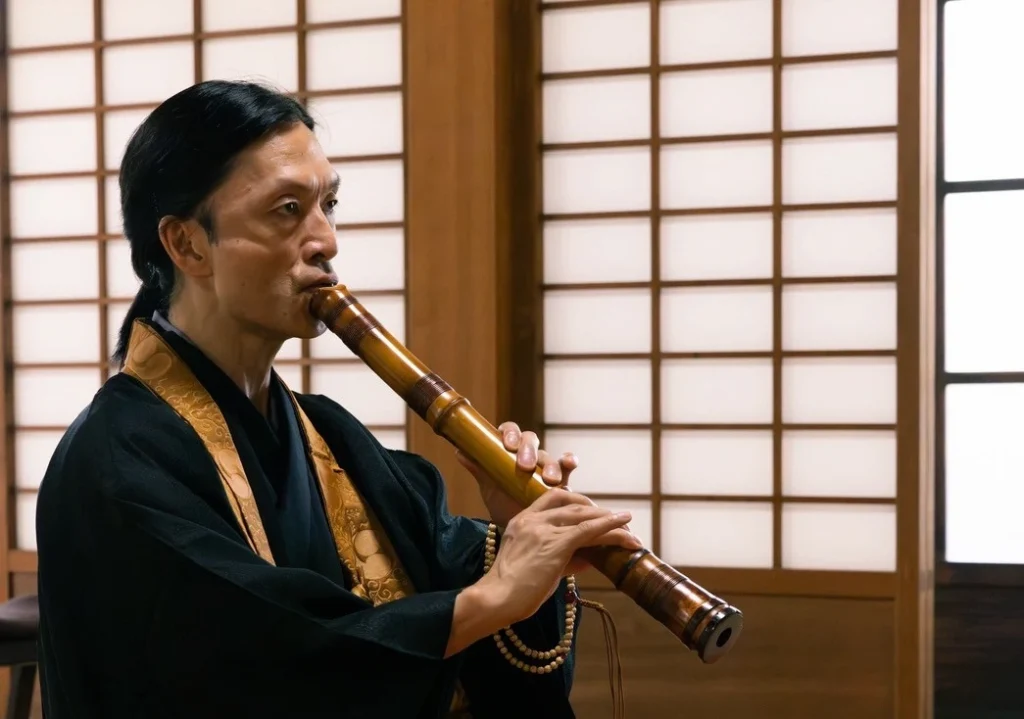
普化明暗尺八導主 / 尺八奏者(虚無僧)

京都・東福寺塔頭善慧院に再興された、普化正宗総本山・虚霊山明暗寺に伝わる明暗尺八の導主の一人。明暗寺は尺八吹奏を通じた禅修行「吹禅」の伝統を今に受け継いできた寺院である。
京都を拠点に、寺院での献奏や虚無僧行化、ホールでの演奏会などを行い、明暗尺八の継承・普及に努めている。

「尺八は単なる楽器ではなく、息を整え、心を静めるための法具でした。」
― 石橋 聲月
Seigetsu Ishibashi – Profile
Myoan Fuke Shakuhachi Master / Komusō Shakuhachi Player
Seigetsu Ishibashi is one of the Myoan Fuke shakuhachi masters at Kyorei-zan Myoan-ji, the head temple of the Fuke Myoan tradition revived within Zenkei-in, a sub-temple of Tōfuku-ji in Kyoto. At Myoan-ji, the tradition of suizen—Zen practice through shakuhachi playing—has been handed down to the present day.
Based in Kyoto, he offers dedicatory performances at temples, undertakes mendicant practice in komusō attire, and gives concerts in halls and other venues, working to preserve and transmit the Myoan shakuhachi tradition.
“The shakuhachi was never just an instrument; it was a dharma tool for settling the breath and quieting the mind.”
— Seigetsu Ishibash
普化宗大本山「明暗寺」
導主 石橋聲月師に聞く、
受け継がれる明暗尺八のこころ
名の由来
「聲月(せいげつ)」というのは本名ではなく、「竹号(ちくごう)」と呼ばれる名前です。竹号とは、尺八奏者が師匠から授かる芸名のようなもので、書道などでいう「雅号」にあたります。尺八が竹で作られていることから「竹号」と呼ばれています。
私の師匠である谷北一声(たにきた・いっせい)先生の「せい」を頂き、「聲月」と名乗るようになりました。
尺八との出会い
出会いは今からおよそ20年前、30歳の頃でした。それまで抱いていた思いを諦めざるを得ず、虚しさを感じていた時期がありました。京都の大徳寺の近くに住んでおり、以前から仏教にも関心があったため、毎週土曜日に参禅していました。あるとき、住職から虚無僧の話を伺い、その伝統が今も続いていることを知りました。
さらに京都にある明暗寺がその本山であると聞き、すぐに問い合わせをしました。そういう意味では、私にとって尺八との出会いは、音楽的な興味というよりも「虚無僧という存在」に惹かれたことが始まりだったのだと思います。
尺八に救われた日々
尺八を吹き始めて間もなく、「これだ」と感じました。夢中で吹いているうちに、いつの間にか挫折感や悩みが消えていたのです。それよりも、尺八の練習や歴史を学ぶことにのめり込んでいました。今思えば、当時の苦しみは自分自身が作り出していた思い込みのようなものだったのかもしれません。尺八に出会ったことで、生き方そのものが変わったと感じています。また、尺八を吹いているときは「頭が空っぽのようで、同時にフル回転している」という不思議な感覚になります。これは心のバランスを保つうえで、とても良い作用をもたらしてくれていると感じます。
虚無僧とは
虚無僧の起源は鎌倉時代にさかのぼります。中国の普化和尚の教えが日本に伝わり、普化宗として広まりました。その修行の道具として用いられたのが尺八です。尺八は単なる楽器ではなく、息を整え、心を静めるための法具でした。虚無僧がかぶる深い編笠は「天蓋(てんがい)」と呼ばれます。これは顔を隠すためだけではなく、「我」を捨て、無の境地に至るための象徴です。外の世界との境を閉じ、自らの内に静かに向き合うためのものといわれています。江戸時代になると、虚無僧たちは尺八を吹きながら各地を行脚し、托鉢を通して修行を重ねていました。
それにともない、虚無僧の寺院や道場も各地に建てられ、普化宗の教えが全国へと広がっていきました。
「半僧半俗」という生き方
虚無僧を表す言葉に「半僧半俗(はんそうはんぞく)」というものがあります。これは、戒律の中で守るべきことは守りながらも、世俗の生活も大切にするという考え方です。家族を養うこと、職場で気配りをすること、そうした日常の営みも修行の一部であり、どちらもおろそかにしない。そのような「正直に生きる」姿こそ、最も自然で良い生き方ではないかと思います。私自身も、尺八を吹いている時だけは清らかな気持ちになり、俗世から離れる感覚を覚えます。
吹禅行化誓願文(すいぜんぎょうけせいがんもん)
虚無僧が尺八を吹く修行、それを「吹禅(すいぜん)」といいます。
その際に唱える誓いの言葉が「吹禅行化誓願文」です。
一吹為断一切悪(いっすい いだん いっさいあく)
一吹(ひとふき)すれば、あらゆる悪を断ち切る。心の迷いや煩悩を断ち、悪しき心を離れるという誓い。
二吹為修一切善(にすい いしゅう いっさいぜん)
二吹すれば、すべての善を修す。善い行い・清らかな心を育てるという誓い。
三吹為度諸衆生(さんすい いど しょしゅじょう)
三吹すれば、あまねく衆生を度す。尺八の音が自らの修行だけでなく、他者をも救う働きとなるようにという誓い。
皆共成仏道(かいぐ じょうぶつどう)みなともに仏の道を成す。自他ともに悟りの境地に至ることを願う、締めの一句。私たちはいつも、この四つの誓いを胸に刻みながら尺八を吹いています。
日本の若い世代へ
現在、免許皆伝を取得する人のうち、5人中4人は日本以外の方です。
免許皆伝を得ると師家として弟子を育てることが許されます。皆さん自国で積極的に弟子を育てています。その結果として、海外の修行者が急増しています。外国の方から注目をいただけるのは大変嬉しいことですが、日本人の割合が減っていることに少し寂しさも感じます。明暗尺八はすばらしいものであり、後世に伝えていく価値があると感じています。もし日本の若い世代の方々の中で少しでも興味を持たれた方がいれば、ぜひこの伝統に触れてみてほしい。そして共に、明暗尺八の音を未来へとつないでいければと願っています。
An Interview with Shōgetsu Ishibashi, Dōshu of Myōan-ji, the Head Temple of Fuke-shū:
The Spirit of the Myōan Shakuhachi, Passed Down Through Generations
The origin of the name
“Shōgetsu (聲月)” is not my birth name. It is what we call a chikugō—a name bestowed within the shakuhachi tradition. A chikugō is essentially an artistic name granted by one’s master, similar to a calligrapher’s gagō (art name). Because the shakuhachi is made of bamboo, it is called a “bamboo name.”
I received the “sei” from my teacher, Issei Tanikita, and began using the name “Shōgetsu.”
Encountering the shakuhachi
My first encounter was about twenty years ago, when I was around thirty. At the time, I had been forced to give up on hopes I once held, and I was going through a period of emptiness. I lived near Daitoku-ji in Kyoto, and I had long been interested in Buddhism, so I practiced sanzen (Zen training/interviews) every Saturday.
One day, the head priest told me about the komusō and I learned that their tradition still continued today. I also heard that Myōan-ji in Kyoto is the head temple, and I contacted them immediately. In that sense, my encounter with the shakuhachi began not so much from musical interest as from being drawn to the very existence of the komusō.
The days the shakuhachi saved me
Soon after I began playing the shakuhachi, I felt, “This is it.” As I immersed myself in playing, my sense of frustration and worry faded away before I knew it. Instead, I became absorbed in practice and in learning the instrument’s history. Looking back, the suffering I felt then may have been a kind of self-created assumption. Meeting the shakuhachi changed my entire way of living.
When I play, I enter a strange state—my mind feels empty, and yet at the same time it is working at full speed. I feel it has a very positive effect on maintaining inner balance.
Who are the komusō?
The origins of the komusō go back to the Kamakura period. The teachings of Zen Master Puhua from China were transmitted to Japan and spread as Fuke-shū. The shakuhachi was used as a tool for training. It was not merely a musical instrument, but a ritual implement for regulating the breath and calming the mind.
The deep woven basket hat worn by the komusō is called a tengai. It is not only to hide the face, but a symbol of casting off the ego and reaching the state of emptiness. It is said to close off the boundary with the outside world, so one can quietly face inward.
In the Edo period, komusō traveled through many regions while playing the shakuhachi, continuing their training through takuhatsu (alms-begging). Along with this, temples and training halls for komusō were built across the country, and the teachings of Fuke-shū spread nationwide.
A way of life: “half monk, half layperson”
There is a phrase used to describe the komusō: hansō-hanzoku—“half monk, half layperson.” It means that while one keeps what should be kept within the precepts, one also values life in the secular world. Supporting one’s family, showing consideration in the workplace—these daily activities are also part of training, and neither should be neglected.
I believe that such a way of living—living honestly—is the most natural and best path. For myself as well, when I play the shakuhachi, I become pure in spirit and feel as though I have stepped away from the worldly realm.
Suizen Gyōke Seiganmon (Vows for the practice of Suizen)
The practice in which komusō train by blowing the shakuhachi is called suizen (“blowing Zen”). The vow recited at that time is the Suizen Gyōke Seiganmon.
Issui i-dan issai-aku
With one blow, I cut off all evil—vowing to sever delusion and afflictions, and to leave behind unwholesome states of mind.
Nisui i-shū issai-zen
With two blows, I cultivate all good—vowing to nurture good conduct and a pure heart.
Sansui i-do sho-shujō
With three blows, I deliver all sentient beings—vowing that the sound of the shakuhachi will not only be for one’s own practice, but will also serve to help others.
Kaigu jōbutsudō
May we all together fulfill the Buddha’s path—these closing words express the wish that both self and others may reach awakening.
We always play the shakuhachi with these four vows engraved in our hearts.
To Japan’s younger generation
Today, among those who obtain menkyo kaiden (full transmission), four out of five are from outside Japan. Receiving menkyo kaiden allows one to become a master and train disciples. Many of them actively teach students in their home countries, and as a result, the number of practitioners abroad is rapidly increasing.
It makes me truly happy that people from overseas take such interest, but I also feel a certain sadness that the proportion of Japanese is decreasing. The Myōan shakuhachi is something truly wonderful, and I believe it is worth passing on to future generations. If any young people in Japan feel even a slight interest, I hope you will come and experience this tradition for yourself. And together, I wish that we can carry the sound of the Myōan shakuhachi into the future.