

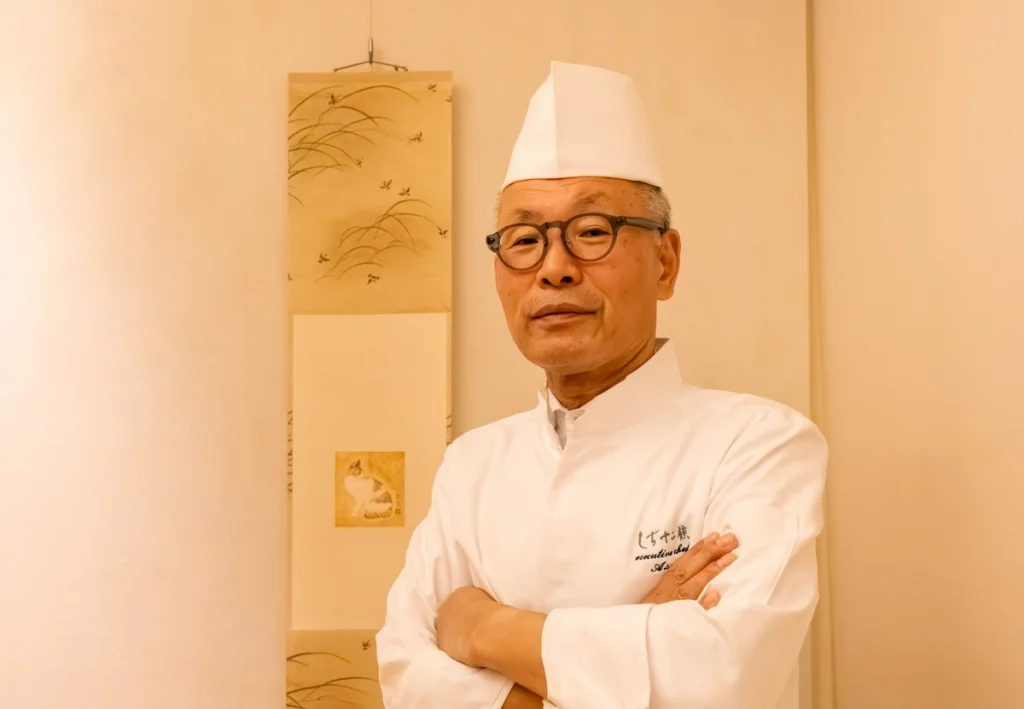
和食料理家/「丸の内一丁目 しち十二候」代表兼総料理長

福岡県筑後市出身。グランドハイアット東京、コンラッド東京にて日本料理の料理長・エグゼクティブシェフを歴任したのち、東京ステーションホテルB1F「丸の内一丁目 しち十二候(日本料理・鉄板焼)」の代表兼総料理長として、二十四節気・七十二候の移ろいを一献に映す会席と鉄板焼を監修している。

卓越した技能者(現代の名工/2023年)、黄綬褒章(2024年)、東京都優秀技能者(東京マイスター/2008年)など数々の顕彰を受けるとともに、「日本食普及の親善大使」として日本料理の魅力を国内外に伝えてきた。季節の声に耳を澄まし、出汁・乾物・発酵を礎に素材が語る温度と香りを設計することで、七十二候の移ろいを一皿に織り込むことを大切にしている。器と間合い、所作ともてなし——余白を活かし、過剰を削ぎ、必要なものだけを残すことで、からだと心が自然に整う料理を追求している。
Akio Saito – Profile
Japanese Cuisine Chef / Executive Chef with Representative Authority, “Marunouchi 1-chome Shichi Jyu Ni Kou”
Born in Chikugo, Fukuoka, Akio Saito served as Japanese cuisine chef and executive chef at Grand Hyatt Tokyo and Conrad Tokyo before becoming Executive Chef with representative authority at “Marunouchi 1-chome Shichi Jyu Ni Kou” (Japanese Cuisine & Teppanyaki) on the B1 level of The Tokyo Station Hotel. There, he oversees kaiseki and teppanyaki that express Japan’s 24 seasons and 72 micro-seasons in each course.
His honors include Contemporary Master Craftsman (2023), the Medal with Yellow Ribbon (2024), and Tokyo Excellent Technician (Tokyo Meister, 2008). As a “Japanese Cuisine Goodwill Ambassador,” he has also played an active role in promoting Japanese food culture in Japan and abroad.
Listening closely to the voice of the season, he bases his cuisine on dashi, preserved ingredients, and fermentation, designing heat, aroma, vessels, and pacing so that the ingredients speak for themselves. By embracing empty space, subtracting the excess, and keeping only what is essential, he seeks to create dishes through which the body and mind naturally return to a calm equilibrium.
料理哲学
季の声を聴き、余白で仕上げる。
七十二候の移ろいを台所の暦とし、出汁・乾物・発酵を礎に、素材が語る温度と香りを設計する。器と間合い、所作ともてなし——すべては一献の静けさへ。過剰を削ぎ、必要を残すことで、からだと心は自然に整う。
Core Statement
Listen to the season; finish with quiet space.
Guided by Japan’s 72 micro-seasons, I build flavor on dashi, preserved foods, and fermentation—designing heat, aroma, vessels, and pace so the ingredient speaks. By subtracting the excess and keeping what is essential, the body and mind find a calm equilibrium.
しち十二候 CEO
斎藤章雄 氏に聞く、料理という「道」を歩くこと
18歳、料理との出会い
私が料理の世界に入ったのは、18歳の一歩手前ぐらいの時でした。高校を途中でやめてしまったので、叔母から「手に仕事を持っていたほうがいい」と紹介されたのが、福岡、博多での始まりです。
もし紹介されたのが大工さんだったら、大工さんになっていたかもしれません。
当時は志があったわけではなく、「いつやめようかな」と思いながら毎日14~15時間は働いていました。
ふと気づいたら3年が経っており、仲間と遊んでいる時に「3年もやってからまた新たに違う仕事をするのはもったいない。これを続けていれば次は6年になる」と考え、やめるのを一転して続けることにしました。
職人の世界の人間形成
当時の料理長に「しっかり勉強してやろうと思います」と伝えると、岐阜の料理旅館を紹介されました。
そこには職人の世界特有のバランスがありました。給料は安いですが、住むところも食べるものも困りません。先輩や師匠が全部払うので、後輩がお金を払うことはありません。そういう環境の中で人間形成がなされてきました。その後、師匠の移動に伴い、佐賀県、北九州、フィリピンなどを渡り歩きました。
暗闇の中のスイッチを探すように、基礎を体に染み込ませる料理人の業界というのは、「10年が一区切り」です。その10年のうちにどれだけ吸収して自分を形成できるかが大切です。
例えば新しく引っ越した家の初日は、真っ暗だとどこに何があるか分かりませんが、半年も経てば、暗闇の中でどこにスイッチがあってどこに扉があるか、誰に教えられなくてもいつの間にか自分の体に染みついて、できるようになります。料理を作るということも同じなのです。
この土台となる基礎というものを体に染み込ませておかないと、想像力を豊かにしていくことは厳しいです。
グローバルになればなるほど、対応をその場で変更していく自分や、相手が求めているものをキャッチできる自分が必要になります。10回やった人、100回やった人、1万回やった人とでは、おのずとレベルが違ってきます。
41歳での大学入学と「螺旋階段」の教え
29歳の時に東京・銀座の「白田」で初めて料理長になりました。その後、小田急グループに12年ほどいて、静岡に新設したホテルの立ち上げでマネージャー兼料理長もやりました。
その頃、41歳の時に大学に行き始めました。観光学を学ぶためです。料理の外にいる、常に俯瞰して見られる人たちと組んでいかないと物事の本質は分からないと感じました。
ゼミの教授が言っていたのは、「時代は変わるけれど、自分の軸をしっかり持って、芯の部分を問い続けていくことが重要だ」ということです。現状は螺旋階段の下の方にいる。そこからその螺旋階段を上に上がっていくという意識が大切。「芯」を変えないまま進化し続ける。手書きがデジタルになろうが、この芯がないと続けていけないという教えは、非常に勉強になりました。
ホテルの効率化と、日本料理の「アベレージ化」への疑問
グランドハイアット東京やコンラッド東京といった外資系ホテルにもいましたが、世界のホテルチェーンというのは、ベースが基本的にフランス料理なのです。
日本料理というのはとてもコスト高で、ホテルという組織の中では効率や予算の中でどうしても厳しくなります。しかし、効率化されてアベレージ化されていくと、その店らしさが失われ、個性は失われていきます。
職人の個性を大切にするという思いを自分で形にしたいと考えて「しち十二候」を始めました。
「しち十二候」に込めた、季節の移ろいへの想い
私のお店「しち十二候」という名前は、季節の変化を表す七十二候からきています。ホテル時代、数ヶ月前から献立の計画を立てていましたが、実際の季節感と外れてしまうことがありました。
料理は、季節の移ろいの中にあるものです。あえて何月何日からピタッと全部変える必要はなく、その時その時で、徐々に料理が変わっていってもいいのではないかと考えました。
ライブ感を大切にして、その日のお客様にその日の料理を伝えられるような場所でありたいと思っています。
日本料理の美しさは「余白」にあります。パソコンで献立は打てますが、書道で字を書いてみればバランスの重要性がわかります。お茶を勉強すれば、次の手がどう動くのか、その所作の意味がわかります。
日本料理も、こうしたものを身につけながら、自分を磨いて少しずつ進化していくことが重要です。
私たちの目指すところは、お客様の笑顔です。お金を払ってくれる価値に見合ったものを一生懸命やった結果、お客様が笑顔で「良かったよ、また来るよ」と言ってくれる。
自分たちがその笑顔に感動できるかどうか、それだけの話なのです。変化のスピードが速い世の中ですが、
「芯の部分」を揺るがせることなく、次の世代へとバトンタッチしていく。
それをこれからも考えていかなければならないと思っています。
Interview with Akio Saito, CEO of Shichi-Juni-Ko
Walking the “Way” of Cooking
Meeting cooking at 18
I entered the world of cooking when I was just shy of 18. I had dropped out of high school, and my aunt told me, “You should have a skill you can rely on.” The job she introduced me to became my starting point—in Hakata, Fukuoka. If she had introduced me to a carpenter instead, I might have become one.
Back then, I didn’t have any particular ambition. I worked 14 to 15 hours a day, thinking, “When should I quit?” But before I knew it, three years had passed. One day, while I was out having fun with friends, I thought: “It would be a waste to start something completely new after doing this for three years. If I keep going, the next milestone will be six years.” And with that, I decided to continue rather than quit.
Being shaped by the craftsmen’s world
When I told the head chef at the time, “I’m going to study seriously and learn,” he introduced me to a ryokan in Gifu known for its cuisine. In that world, there was a distinctive balance unique to craftsmen.
The pay was low, but you never struggled for a place to live or food to eat. Seniors and mentors covered everything, and juniors were not expected to pay. In that environment, you were formed as a person. After that, as my mentor moved, I traveled through places like Saga, Kitakyushu, and even the Philippines.
Letting the basics seep into your body—like searching for a switch in the dark
In the culinary world, people say “ten years is a turning point.” What matters is how much you absorb and how much you shape yourself within those ten years.
For example, on your first day in a new home, if it’s pitch-dark you don’t know where anything is. But after six months, even in the dark, you can find the light switch and the doors. No one has to teach you—you realize your body has learned it.
Cooking is the same. If you don’t let the fundamentals become part of you—your foundation—it’s difficult to enrich your imagination. The more global things become, the more you need to be able to adjust in the moment, and to catch what the other person is truly seeking. Someone who has done something 10 times, 100 times, or 10,000 times—naturally, the level is different.
Entering university at 41, and the lesson of the “spiral staircase”
At 29, I became head chef for the first time at “Shirata” in Ginza, Tokyo. After that, I spent about 12 years with the Odakyu Group. I also served as manager and head chef for the launch of a new hotel in Shizuoka.
Around that time, at 41, I began attending university to study tourism. I felt that unless I worked with people outside the culinary world—people who could always take a bird’s-eye view—I wouldn’t be able to understand the essence of things.
My seminar professor used to say: “Times change, but it’s vital to hold firmly to your own axis—your core—and keep questioning that core.” Right now, you are at the bottom of a spiral staircase. What matters is the intention to keep climbing that spiral staircase upward. You continue evolving without changing your “core.” Whether handwriting becomes digital or not—without that core, you cannot keep going. That teaching was a profound lesson for me.
Hotel efficiency, and doubts about the “averaging” of Japanese cuisine
I also worked at international hotels such as Grand Hyatt Tokyo and Conrad Tokyo. In global hotel chains, the baseline is essentially French cuisine. Japanese cuisine is extremely costly, and within a hotel organization, it inevitably becomes difficult under constraints of efficiency and budget.
But when everything is optimized and averaged out, the character of the establishment disappears—and individuality is lost. I wanted to create something with my own hands that would value the individuality of craftsmen. That is why I started Shichi-Juni-Ko.
The feelings behind “Shichi-Juni-Ko,” and the shifting of the seasons
The name of my restaurant, Shichi-Juni-Ko, comes from the “72 kō”—the traditional micro-seasons that express subtle changes in nature and time.
During my hotel years, we planned menus months in advance, but sometimes they drifted out of sync with what the season actually felt like. Cooking exists within the movement of the seasons. It doesn’t have to change all at once on a fixed date—“from this day, everything switches.” I thought: wouldn’t it be better if the food could change gradually, responding to the moment?
I want this to be a place that values liveness—a place where we can tell the guests of that day what the food of that day is, in that very moment.
The beauty of Japanese cuisine lies in “ma”—in the blank space, the quiet margin. You can type a menu on a computer, but if you try writing characters in calligraphy, you immediately understand how important balance is. If you study tea, you understand how the next movement of the hands unfolds, and what those gestures mean. Japanese cuisine, too, requires you to learn from such disciplines—polish yourself, and evolve little by little.
What we ultimately seek is the guests’ smiles. When we do our utmost in return for the value they pay for, and the guest smiles and says, “That was wonderful—I’ll come again,” everything comes down to whether we can be moved by that smile.
The world is changing at a rapid pace. Even so, without letting our “core” waver, we must keep thinking about how to pass the baton to the next generation. That is what I believe we must continue to do.