

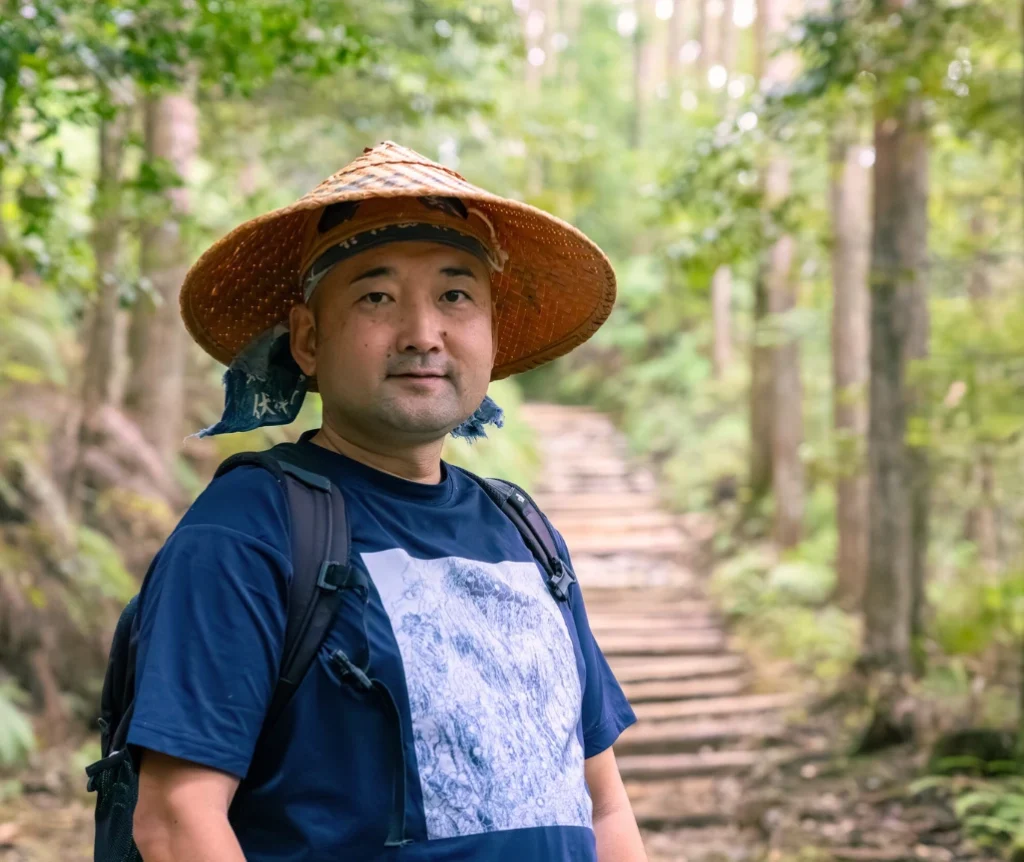
クマノピルグリム代表 / 語り部の会 熊野古道中辺路 会長

和歌山県田辺市を拠点に、世界遺産・熊野古道の語り部として長年活動。
語り部の会「熊野古道中辺路」会長を務め、熊野の自然と信仰、そして“祈りの道”に込められた精神を後世へ伝えている。
同会は2005年にNPO法人化し、年間3万人を超える巡礼者を案内するなど、熊野古道の魅力を国内外へ広めてきた。
山田氏はスペインのサンティアゴ・デ・コンポステーラ巡礼路と熊野古道を歩破した「デュアル・ピルグリム」の称号保持者であり、“巡礼ウォーク”のスペシャリスト。
その語りは、訪れる人々の心に静かな「よみがえり(再生)」の灯をともす。
Yoshinori Yamada
Representative, KUMANO Pilgrim / Chief Storyteller, Kumano Kodo Nakahechi
Based in Tanabe, Wakayama, Yoshinori Yamada leads the Kataribe no Kai Kumano Kodo Nakahechi, a pioneering storytelling association dedicated to preserving and sharing the spirit of the UNESCO World Heritage Kumano Kodo.
Since becoming an NPO in 2005, the group has guided over 30,000 pilgrims each year, offering deep insight into the faith, nature, and history that flow through this sacred path.
A recipient of the prestigious Dual Pilgrim title—awarded to those who have completed both Spain’s Camino de Santiago and Japan’s Kumano Kodo—Yamada is a master of pilgrimage walking.
His stories awaken a quiet remembrance within each traveler: the sense of returning to where the spirit was once born.
ピルグリム(巡礼者)山田 良憲氏に聞く、熊野と巡礼信仰
原点:山岳部、宗教哲学、そして四国遍路へ
高校時代に山岳部に入っていたことが、私の「歩く旅」の原点です。リュックを背負って八ヶ岳やアルプスを1週間ほど歩き回ることも、私にとってはまったく苦ではありませんでした。
その後、大学で宗教哲学を専攻していたとき、先生から「暇だったら行ってみたら面白いよ」
と勧められたのが四国遍路でした。2003年頃で、今と比べるとだいぶ緩い時代でした。
野宿も簡単にできた時代でしたね。
40日くらいかけて30Lのザック1つで放浪しました。若かったこともあって、ただただ毎日が面白かったです。もちろん体力的には過酷でした。1日に40km以上歩いて、熱中症には3回かかりました。
野宿の場所探しでも、神社の軒先で寝ようとして見上げたらスズメバチの巣があって慌てて逃げたり、公園で寝ていたら現役のホームレスの方から「ここは襲われるから逃げた方がいい」と忠告されたり。でも、そうやっていろんな人と関わっていくプロセスそのものが、私の中の「巡礼は面白い」という原風景になりました。
スペイン巡礼と『深夜特急』:バックパック放浪の原型
その後、フランス留学中にはスペインのサンティアゴ巡礼も歩きました。大学院での留学中、寮を出なければならない2か月の空白期間があって、1日3,000円程度で過ごせるという安さにも惹かれました。私は沢木耕太郎の『深夜特急』に影響を受けた世代で、「バックパック1個で放浪する」というスタイルが、自分の原型のイメージとしてありました。そして巡礼がその放浪願望を乗せるのに相性が良くて、非常にやりやすいものでした。
熊野古道への違和感:観光の設計図と巡礼の設計図は違う
熊野古道に深く関わるようになったのは2019年からです。現在の妻が企画した「京都から熊野まで300kmを歩くイベント」に参加したのがきっかけで、熊野も四国やスペインと同じ「巡礼路」として捉えていました。その後、語り部の会に入ってガイドを始めましたが、次第に違和感を覚えるようになりました。今の熊野古道は、日本人の休みに合わせた「1日や2日の短いルート」として考えられています。設計図が「観光」に向けて作られていて、例えば宿も歩く人のための配置になっていないんです。もちろん短い距離を歩くこともそれはそれで良いのですが、一方で、スペインを歩いた経験のある外国人は800km歩くのがベースですから、数日の行程では物足りない。この「長く歩きたい」という需要に応え、京都からの枠組みを復活させたい。そこが、今の私の活動の根っこにあります。
「巡礼信仰」:歩くことで宗教的になる
スペインでも信仰がない人がほとんどですが、特定の宗教への信仰がなくても、巡礼路を歩いていると自然と宗教的になっていく現象が起こります。私の知り合いの研究者はこれを「巡礼信仰」と呼んでいます。これは特定の神仏を対象にするのではなく、「歩く行為そのものが面白く、自分の内面を満足させてくれる」という感覚です。
宗教的な情緒を呼び覚ます仕組みがプロセスの中に畳み込まれているので、教義に縛られず、教会やお寺にただ座っているだけで心地よいと感じる。そんな「信仰は必ずしも必要ではない」状態こそが、今の時代に多くの人を惹きつける魅力だと思います。
歴史研究と展望:長距離巡礼路としての熊野
私は今、平安時代の文献なども研究しています。
今日のガイドが話す「熊野詣」は上皇などが大勢で行う「熊野御幸」が原型ですが、もっと少人数で歩いていた人々がいたはずだと考えていました。
調べてみると、900年代の増基法師の「庵主」にあるように、京都から熊野、伊勢を回って京都へ帰る約800km、1か月がかりの旅の記録が出てくるんです。こうした歴史的なルートに背景や地名、その後の経緯などの肉付けをした資料を作りたいと考えています。
自分が歩き続けるために会社を設立:株式会社クマノピルグリム
私が会社を作ったのも、私自身が毎年、長距離の巡礼を続けたいという思いがありました。
京都~本宮、那智~高野山、田辺~伊勢を歩くイベントを開催すれば紀伊山地の霊場、参詣道を歩くことができます。そのようなイベントを開催し続けたいと思い、会社を作りました。
そうして歩き続ければ、71歳になる頃には、後白河上皇が打ち立てた熊野詣最多記録34回という歴史的最高記録を超えられる計算になります。会社という枠組みがあれば、たとえ私が歩けなくなっても続けてくれる人がいるはずですし、巡礼する人も増えていくはずだと願っています。最終的には、熊野古道のデフォルトが、「庵主」のルート、スペインのように800kmにするのが私の野望です。
Speaking with Pilgrim Yoshinori Yamada: Kumano and the Faith of Pilgrimage
The starting point: mountaineering, philosophy of religion, and the Shikoku Pilgrimage
My origin as a “walking traveler” goes back to high school, when I joined a mountaineering club. Carrying a backpack and trekking through Yatsugatake or the Japanese Alps for about a week was never a hardship for me—it felt completely natural.
Later, when I majored in philosophy of religion at university, a professor suggested, “If you have time, you might find it interesting.” That was how I first set out on the Shikoku Pilgrimage. This was around 2003—compared with today, it was a much looser era. It was easy to camp out overnight.
I wandered for about forty days with a single 30-liter pack. I was young, and every day was simply fascinating.
Of course, physically it was intense. I walked more than 40 kilometers a day and suffered heatstroke three times. Looking for places to sleep brought its own adventures: once I tried to sleep under the eaves of a shrine and looked up to find a hornet’s nest, panicking as I ran away. Another time, I was sleeping in a park when an experienced homeless man warned me, “You’ll get attacked here—better move.”
But that entire process—meeting all kinds of people and being shaped by those encounters—became my original landscape: the moment I realized, “Pilgrimage is endlessly interesting.”
The Camino and Midnight Express: the blueprint of backpack wandering
After that, while studying in France, I also walked the Camino de Santiago in Spain. During my time in graduate school, there was a two-month gap when I had to move out of my dormitory, and I was drawn by the fact that I could live on roughly 3,000 yen a day.
I’m from the generation influenced by Kotaro Sawaki’s Midnight Express, and I carried an image of myself as someone who “wanders with a single backpack.” Pilgrimage was perfectly compatible with that desire to roam—it offered an ideal framework, and it was remarkably easy to commit to.
A sense of dissonance in Kumano: tourism and pilgrimage follow different designs
I began to be deeply involved with the Kumano Kodo from 2019. It started when I joined an event organized by my (now) wife: a 300-kilometer walk from Kyoto to Kumano. To me, Kumano was the same as Shikoku and Spain—a pilgrimage route.
Later, I joined a storytelling and guide association and began guiding, but gradually I started to feel a dissonance. Today’s Kumano Kodo is largely designed as “one- or two-day short routes” aligned with Japanese holiday schedules. The blueprint is oriented toward tourism. Even the placement of accommodations, for example, isn’t arranged for those who truly walk.
Of course, walking shorter distances has its own value. But for many foreigners who have walked Spain, 800 kilometers is the baseline—so a few days can feel unsatisfying. I want to respond to that need—the desire to walk long distances—and revive the Kyoto-based framework. That is the root of what I’m doing now.
“Pilgrimage faith”: walking makes you religious
In Spain as well, most people don’t have explicit religious faith. Yet even without belief in a specific religion, something happens when you walk a pilgrimage route: you naturally become “religious” in a broader sense.
A researcher I know calls this phenomenon “pilgrimage faith.” It isn’t directed toward a particular deity or Buddha. Rather, it’s the feeling that the act of walking itself is meaningful—that it satisfies something within you. The process is designed to awaken religious sensibility, so you aren’t bound by doctrine. You can simply sit in a church or temple and feel at ease.
I believe this state—where “faith isn’t necessarily required”—is exactly what attracts so many people today.
Historical research and a future vision: Kumano as a long-distance pilgrimage route
At present, I’m also researching classical texts from the Heian period. The “Kumano pilgrimage” that guides commonly describe today is based on the model of imperial processions—large-scale journeys by retired emperors and their entourages. But I believed there must also have been people who walked in much smaller groups.
When I looked into it, I found records such as the Anshu of Monk Masuki from the 900s: a journey of roughly 800 kilometers over about one month—Kyoto to Kumano, onward to Ise, and then back to Kyoto.
I want to create materials that flesh out these historical routes—adding background, place names, and the subsequent developments that shaped them.
Founding a company to keep walking: Kumano Pilgrim Inc.
The reason I founded a company is simple: I want to continue long-distance pilgrimages every year myself. If we host walking events—Kyoto to Hongu, Nachi to Koyasan, Tanabe to Ise—we can traverse the sacred sites and pilgrimage paths of the Kii Mountain Range.
I wanted to keep creating those opportunities, and so I built a company.
If I keep walking, by the time I’m 71, I’ll surpass the historical record of 34 Kumano pilgrimages set by Retired Emperor Go-Shirakawa.
And if there is a company as a framework, even if I can no longer walk someday, there will be others who can continue. I hope more and more people will become pilgrims.
Ultimately, my ambition is that the default image of the Kumano Kodo becomes the Anshu route: like Spain, an 800-kilometer pilgrimage.